
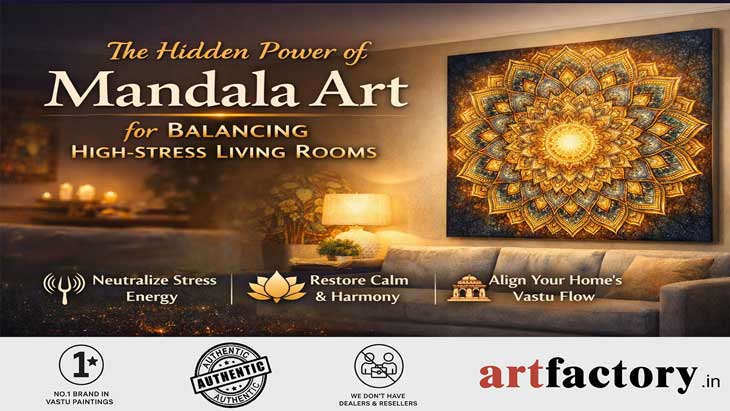
The Hidden Power of Mandala Art for Balancing High-Stress Living Rooms
Key Takeaways
Mandala art acts as an energetic stabilizer for living rooms that experience constant activity and stress.
Radial sacred geometry calms the brain, reducing visual chaos and supporting emotional balance.
In Vastu Shastra, the living room is the energy hub of the home, and a well-placed mandala painting can harmonize its vibrations.
Blue mandala paintings in the North-East direction support meditation, spirituality, and mental clarity.
Mandala symmetry creates a visual focal point, absorbing tension and restoring calmness.
Specific color palettes amplify directional Vastu energy, enhancing peace, prosperity, and positivity.
Modern digital mandala artwork combines ancient sacred geometry with contemporary design, creating high-vibration focal points for modern homes.
Why Your Living Room Is Secretly Absorbing Your Stress
Your living room is more than a space for furniture and entertainment. It is the energetic center of your home.
Every conversation, emotional exchange, and daily activity leaves a subtle energetic imprint in the space. Over time, this accumulation of activity can create energetic clutter, which often manifests as stress or restlessness.
In Vastu Shastra, spaces absorb and reflect the vibrations generated within them. Because the living room is usually the most active area of the home, it becomes a repository of emotional energy.
Many people unknowingly experience the effects of this energetic buildup.
Common signs include:
Feeling mentally tired after spending time in the room
Difficulty relaxing despite comfortable surroundings
Frequent disagreements among family members
A subtle heaviness or restlessness in the environment
While decluttering and improving lighting can help, one powerful yet often overlooked solution is Mandala Art.
Mandala paintings act as visual energy anchors, bringing harmony and balance to spaces filled with activity.
What Is Mandala Art and Why Does It Influence Your Mind?
The word Mandala originates from Sanskrit and means “sacred circle” or “cosmic diagram.”
In spiritual traditions such as Hinduism and Buddhism, mandalas represent the structure of the universe expressed through geometry.
The defining feature of mandala art is radial symmetry, where patterns radiate outward from a central point in perfect balance.
This geometric harmony has a profound psychological impact.
Human perception naturally responds positively to symmetry because it reduces cognitive overload. When our eyes observe balanced patterns, the brain interprets the environment as stable and harmonious.
This is why mandalas are widely used in:
Meditation practices
Sacred architecture
Healing environments
Spiritual artwork
A mandala placed within a home functions as a visual meditation point, guiding the mind toward calmness and focus.
How Mandala Geometry Neutralizes Chaotic Living Room Energy
Modern living rooms often contain multiple sources of stimulation:
Television screens
Digital devices
Bright lighting
Contrasting decorative elements
While these features create a lively environment, they can also produce visual and energetic imbalance.
Mandala art works differently from ordinary decoration.
Instead of adding more visual stimulation, it introduces structured harmony.
Three core principles explain its balancing effect.
1. Radial Balance
The symmetrical design distributes visual attention evenly, reducing mental fatigue.
2. Central Anchoring
The center of the mandala acts as a grounding point, stabilizing the energy of the room.
3. Repetitive Geometry
Repetition creates rhythm, which encourages relaxation and mental clarity.
This is why sacred geometry has been used in temples and meditation halls for centuries.
The Concept of Frequency Anchoring in Interior Energy Design
Modern interior design increasingly integrates ideas from environmental psychology and sacred geometry.
One emerging concept is called Frequency Anchoring.
This principle suggests that a space becomes energetically stable when it contains a strong focal point of harmonious geometry.
Mandala art functions as this focal point.
When placed strategically, it can:
Reduce visual chaos
Encourage calm conversation
Promote emotional harmony
Make the space feel grounded and peaceful
In simple terms, mandala art works like a visual stabilizer for the room’s atmosphere.
Which Mandala Colors Work Best for Living Rooms?
Color plays a powerful role in Vastu because each direction is governed by a particular element.
Selecting the right color ensures the mandala strengthens the natural energy of the space.
| Mandala Color | Emotional Effect | Ideal Direction | Vastu Benefit |
|---|---|---|---|
| Blue Mandala | Deep calm and mental clarity | North-East | Meditation, spirituality, wisdom |
| Green Mandala | Healing and growth | East | Fresh energy and vitality |
| Gold Mandala | Prosperity and abundance | North | Opportunities and success |
| Red / Orange Mandala | Passion and recognition | South | Fame and confidence |
| White Mandala | Purity and balance | Center | Emotional harmony |
Among these options, blue mandalas are especially powerful for stress relief because blue tones naturally calm the nervous system.
Why Blue Mandala Art Is Ideal for the North-East Direction
In Vastu Shastra, the North-East direction is considered the most sacred zone of the home.
It is associated with:
Spiritual growth
Mental clarity
Meditation
Divine connection
This direction is governed by the Water element, which represents purity and flow.
A Blue Mandala Painting in the North-East aligns perfectly with this energy.
Benefits include:
Creating a peaceful atmosphere in the living room
Encouraging mindfulness and thoughtful conversations
Supporting meditation and spiritual reflection
Enhancing mental clarity for decision-making
For homes where the living room occupies the North-East zone, a blue mandala canvas becomes a powerful Vastu remedy.
Where Should Mandala Art Be Placed in the Living Room?
Placement determines whether artwork supports or disturbs the energy flow.
Here are the most effective positions.
North-East Wall
Best location for blue mandala paintings supporting meditation and spiritual clarity.
East Wall
Green mandalas here promote creativity, optimism, and lively conversations.
North Wall
Gold or blue mandalas enhance opportunities and professional growth.
Central Wall Facing Seating Area
This position creates a strong visual anchor, stabilizing the entire room.
Avoid placing mandalas:
Behind cluttered furniture
Near broken décor
In areas with excessive visual distractions
The mandala should always remain the focal point of the wall.
Step-by-Step Guide to Transform a Stressful Living Room with Mandala Art
Here is a simple method used by many Vastu consultants.
Step 1 – Identify the Dominant Wall
Look for the wall that naturally attracts attention, usually the one facing the sofa.
Step 2 – Choose the Right Mandala Design
Select a design with:
Clear radial symmetry
Balanced color palette
A strong central point
Step 3 – Align the Color with Direction
For example:
Blue mandala → North-East
Green mandala → East
Gold mandala → North
Step 4 – Create a Strong Focal Point
Hang the mandala at eye level above seating areas.
Step 5 – Reduce Visual Clutter Around It
Allow the mandala to stand out by keeping nearby décor minimal.
Case Study: A Modern Apartment Transformation
Consider a typical urban apartment living room.
The space contained:
Dark abstract artwork
Bright television lighting
Multiple decorative elements competing for attention
Family members often reported feeling mentally exhausted after work.
A Vastu consultant recommended placing a large blue mandala painting in the North-East section of the living room.
Additional changes included:
Removing two visually chaotic artworks
Adding soft warm lighting
Introducing a small indoor plant nearby
Within a few weeks, the family reported a noticeable shift.
The living room felt calmer, conversations became more relaxed, and the environment felt more balanced and peaceful.
Why Digital Mandala Art Is the Future of Sacred Geometry Décor
Traditional mandalas were painted by hand in spiritual settings.
Today, digital design tools allow artists to create perfectly symmetrical sacred geometry patterns.
Advantages of modern digital mandala artwork include:
Precise mathematical symmetry
Custom color palettes aligned with Vastu principles
High-resolution canvas printing
Adaptability for modern interiors
This fusion of ancient wisdom and modern technology creates artwork that resonates with both spiritual and contemporary aesthetics.
Practical Vastu Tips for Using Mandala Art
Here are some expert recommendations.
Place mandalas behind the main seating area
This stabilizes the emotional atmosphere of the room.
Use soft lighting near the artwork
Warm light enhances the calming effect.
Choose balanced frames
Circular or symmetrical frames work best.
Combine mandalas with natural elements
Plants and wooden furniture strengthen grounding energy.
FAQ: Mandala Art and Living Room Energy
Can mandala art reduce stress in a living room?
Yes, symmetrical geometry and calming colors create a visually balanced environment that promotes relaxation.
Which direction is best for mandala art in Vastu?
North-East is ideal, especially for blue mandala paintings that support meditation and clarity.
What size mandala painting works best?
Large focal mandalas between 24–48 inches are ideal for living rooms.
Can mandala art work in modern minimalist homes?
Yes, mandalas complement minimalist interiors by acting as a single powerful focal point.
Are digital mandalas effective for Vastu décor?
Yes, digital mandalas provide perfect symmetry and customizable colors aligned with Vastu directions.
Final Thoughts
Modern life brings constant stimulation, and our homes often absorb that stress.
Your living room should not become a container for tension—it should become a space of restoration and harmony.
Mandala art offers a powerful yet elegant solution.
Through sacred geometry, balanced colors, and correct placement, mandalas can transform a busy living room into a sanctuary of calm energy.
When combined with Vastu principles, especially placing a blue mandala in the North-East, this ancient art becomes a powerful tool for creating emotional balance in modern homes.
Sometimes, restoring harmony in your home begins with a single perfectly balanced circle on your wall.
Comments : (0)