
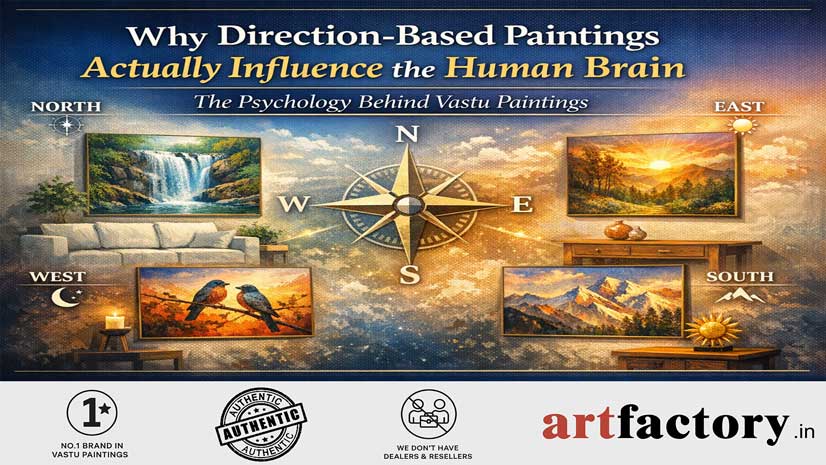
Why Direction-Based Paintings Actually Influence the Human Brain The Psychology Behind Vastu Paintings
Key Takeaways
Direction-based paintings influence the human brain through visual psychology, environmental cues, and subconscious symbolism.
The brain constantly interprets color, motion, natural imagery, and spatial placement, which can affect mood, motivation, and decision-making.
Vastu principles align with modern environmental psychology, which shows that surroundings impact cognition, emotions, and productivity.
For example, water imagery in the North stimulates opportunity thinking, while mountain imagery in the South-West creates a sense of stability and security.
Direction-based décor works because it combines visual triggers, spatial orientation, and symbolic meaning, creating powerful subconscious associations.
When paintings are placed strategically, they can influence focus, calmness, ambition, emotional bonding, and financial mindset.
Introduction: Why Certain Paintings Instantly Change the Energy of a Room
Have you ever entered a room and immediately felt calm, motivated, or emotionally uplifted — without knowing why?
Often, the answer lies in visual cues embedded in the environment.
The human brain processes images 60,000 times faster than text, and the surrounding visuals silently shape our mental state. This is the core reason why direction-based paintings used in Vastu and Feng Shui feel powerful to many people.
While ancient traditions described these effects through elements and directions, modern psychology explains them through environmental conditioning, visual symbolism, and spatial cognition.
When the two perspectives are combined, something interesting emerges:
Strategically placed imagery can influence emotional and cognitive patterns in subtle but measurable ways.
This article explores the science, psychology, and practical logic behind direction-based Vastu paintings.
How the Human Brain Responds to Visual Environments
Environmental psychology confirms a simple truth:
Our surroundings shape our thoughts, emotions, and behavior.
Research in workplace design and neuroscience shows that the brain constantly scans the environment for signals related to:
Safety
Opportunity
Movement
Stability
Social connection
Paintings are powerful because they activate mental imagery networks in the brain.
For example:
Flowing water imagery can stimulate forward movement and opportunity thinking
Mountains create a perception of support and grounding
Birds or open skies trigger freedom and aspiration
These responses are not mystical — they are deeply rooted evolutionary signals.
Humans evolved in natural landscapes where recognizing water, mountains, forests, and sunlight had survival benefits.
This explains why nature-inspired paintings feel calming or motivating even in modern homes.
Why Direction Matters: The Brain's Spatial Orientation System
Humans possess an internal navigation system known as spatial cognition.
Our brain constantly tracks:
Direction
Light sources
Movement in space
This is why rooms facing certain directions feel different psychologically.
For example:
Morning sunlight from the East tends to increase alertness and mood.
North-facing spaces often feel calm and balanced due to indirect light.
Ancient Vastu principles aligned décor with directional energy patterns, while modern science describes the same concept through:
Circadian rhythm
Light psychology
Environmental orientation
When a painting is placed in a direction that matches its symbolic meaning, the brain perceives greater harmony.
Why Symbolic Imagery Works: The Power of Subconscious Associations
The human mind responds strongly to symbols and archetypes.
These associations operate subconsciously.
For instance:
| Symbol in Painting | Psychological Signal | Mental Effect |
|---|---|---|
| Flowing Water | Opportunity and movement | Encourages progress mindset |
| Mountains | Stability and strength | Creates emotional security |
| Rising Sun | Hope and renewal | Boosts optimism |
| Flying Birds | Freedom and expansion | Stimulates creativity |
| Pair of Birds | Connection and bonding | Supports emotional harmony |
These symbolic signals are why direction-based paintings feel meaningful and impactful.
They provide visual reinforcement of the mindset people want to cultivate.
The Hidden Psychological Mechanism Behind Vastu Paintings
Direction-based paintings influence people through four core psychological mechanisms.
1. Visual Priming
Visual priming means that images influence future thoughts and decisions.
Example:
Seeing flowing water regularly can subtly reinforce ideas of movement and opportunity.
2. Emotional Conditioning
Repeated exposure to calming imagery can reduce stress and improve mood.
This is why nature paintings are widely used in:
hospitals
therapy spaces
corporate offices
3. Environmental Anchoring
When a specific area of the home consistently represents a theme — like prosperity or stability — the brain forms a mental association with that space.
4. Behavioral Nudging
Certain imagery nudges behavior.
For example:
Motivational visuals increase productivity.
Peaceful visuals encourage relaxation.
Direction-Based Painting Guide (Psychology + Vastu Logic)
Below is a simplified framework combining environmental psychology with traditional directional symbolism.
| Direction | Psychological Theme | Ideal Painting Type | Brain Impact |
|---|---|---|---|
| North | Opportunity | Waterfalls, rivers | Encourages progress mindset |
| North-East | Clarity | Meditation scenes, serene water | Enhances calm thinking |
| East | Growth | Rising sun, green forests | Boosts motivation |
| South-East | Financial energy | Dynamic abstract art | Activates action mindset |
| South | Fame & recognition | Sunlight, fire imagery | Builds confidence |
| South-West | Stability | Mountains, earthy landscapes | Creates security |
| West | Reflection | Creative abstract art | Encourages imagination |
This alignment works because the symbolism reinforces the psychological purpose of each space.
Case Study: How Visual Environment Changed a Work-From-Home Office
Consider a hypothetical scenario.
A professional working from home reported constant procrastination and low motivation.
The workspace initially contained:
blank walls
poor lighting
no visual inspiration
After redesigning the space using direction-based imagery:
North wall: waterfall painting
East wall: sunrise landscape
Within weeks the individual reported:
improved morning productivity
clearer focus
stronger sense of momentum
While paintings alone do not magically create success, they shape the environment that supports productive thinking.
Step-by-Step Guide: How to Use Direction-Based Paintings at Home
Step 1 — Identify the Direction of Your Wall
Use a compass or smartphone compass app to determine the wall direction.
Step 2 — Define the Intention of the Space
Ask:
Do you want the room to promote:
career focus
relaxation
creativity
relationship harmony
Step 3 — Choose Symbolic Imagery
Select artwork that visually represents your intention.
Examples:
Water imagery for opportunity
Mountains for stability
Step 4 — Use Color Psychology
Colors also influence emotions:
Blue → calm thinking
Green → growth and vitality
Red → energy and recognition
Step 5 — Keep the Visual Message Clear
Avoid clutter.
One powerful painting works better than many unrelated visuals.
Why Most Vastu Painting Advice Fails
Many sellers present Vastu paintings as magical solutions.
That approach damages credibility.
The real value lies in environmental design principles.
Paintings work when they:
match the emotional purpose of the space
use meaningful symbols
align with natural lighting and direction
Without thoughtful placement, paintings become decor instead of psychological tools.
Future of Vastu Art: Blending Ancient Wisdom with Modern Psychology
The next generation of Vastu-inspired décor will likely combine:
neuroscience insights
environmental psychology
visual design principles
spatial planning
Rather than treating paintings as superstition, they can be understood as intentional visual programming for the human mind.
Homes designed with this philosophy feel:
calmer
more inspiring
psychologically supportive
Frequently Asked Questions
Do Vastu paintings scientifically influence the brain?
They influence the brain indirectly through visual psychology, environmental cues, and symbolic associations.
Why does water imagery feel calming?
The human brain evolved near water sources, so flowing water imagery signals safety and opportunity.
Can paintings improve productivity?
Motivational imagery and nature scenes can improve focus and mood, which indirectly boosts productivity.
Why is direction important in Vastu décor?
Direction affects natural light, spatial perception, and how the brain experiences a room.
Are Vastu paintings spiritual or psychological?
They can be both, but their effects can largely be explained through environmental psychology.
Conclusion
Direction-based paintings are powerful not because of superstition, but because they combine visual symbolism, environmental psychology, and spatial awareness.
When thoughtfully placed, artwork can subtly influence how people think, feel, and behave inside their homes.
By understanding why certain images affect the mind, homeowners can design spaces that support clarity, motivation, emotional balance, and personal growth.
In essence, the right painting in the right direction does more than decorate a wall — it programs the emotional experience of the space.
Explore our directionwise paintings click here
Comments : (0)